
Figuring out what you should actually pay for a cab in Saudi Arabia can feel like guesswork if you’ve never traveled here before. City taxis run on meters, ride-hailing apps quote surge prices that jump around depending on the hour, and intercity routes between Jeddah, Makkah, Madinah, and Riyadh are priced completely differently from a five-minute hop across town. If you’ve ever wondered why one driver quoted you 15 SAR for a short ride while another wanted 150 SAR for what felt like a similar distance, the answer usually comes down to which pricing system you’re dealing with, not whether you’re being overcharged.
This guide breaks down exactly how cab fares work across the Kingdom — local city rates, airport transfers, ride-hailing app pricing, and the long-distance routes pilgrims and travelers rely on most — so you know what a fair price looks like before you ever get in a car. We’ll also walk through how Al Haram Cab fixed-fare model fits into all of this, and why it tends to work out better for anyone traveling with family, luggage, or a group rather than hopping in and out of short city rides.
How Cab Fares Work in Saudi Arabia
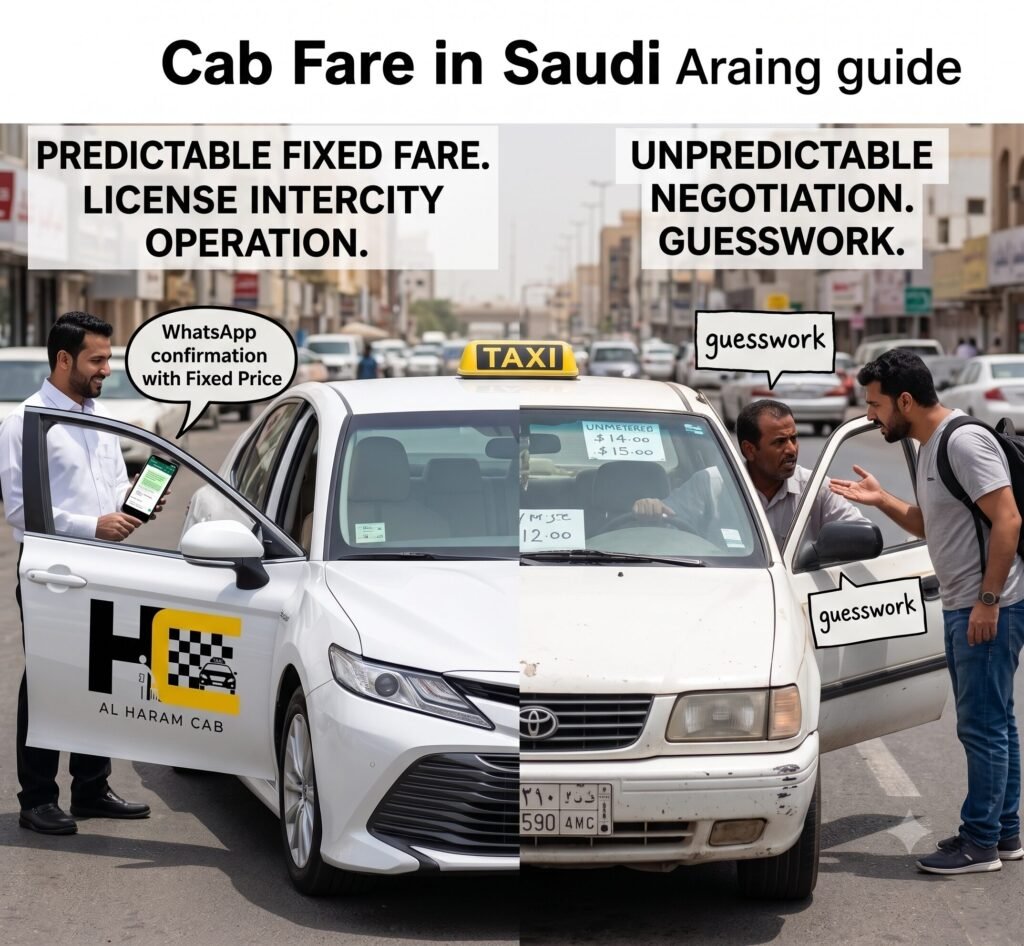
Saudi Arabia actually runs two very different taxi systems side by side, and knowing which one you’re dealing with matters a lot. Licensed metered taxis — usually green or turquoise vehicles — calculate your fare automatically using a taximeter based on distance and time, and by law you’re not required to pay if the driver hasn’t switched the meter on. Older white taxis, by contrast, typically don’t run a meter at all, which means the price is whatever you negotiate with the driver before the trip starts, and that’s exactly where visitors unfamiliar with local rates tend to get overcharged. For longer intercity journeys, neither of these city-taxi systems really applies — operators like Al Haram Cab instead quote a single fixed, all-inclusive price per vehicle, agreed in writing over WhatsApp before you travel, which sidesteps the whole meter-versus-negotiation question entirely for trips between cities.
Think of these as three separate pricing worlds: metered city taxis for short local trips, ride-hailing apps with dynamic pricing for on-demand rides, and fixed-fare intercity operators for journeys between Saudi Arabia’s major cities and holy sites. Mixing them up is where most frustration comes from — trying to flag down a metered taxi for an 850-kilometer trip to Madinah simply isn’t how that route is priced in practice.
Local City Taxi Fares
Within any single city — Riyadh, Jeddah, Makkah, Madinah, Dammam, or Taif — a standard metered taxi typically starts with a base fare somewhere in the 10 to 15 SAR range before you’ve traveled a single kilometer. From there, distance is charged at roughly 2.5 to 3 SAR per kilometer on average, though this varies slightly by city and can rise during heavy traffic since some meters factor in waiting time as well as distance. A short five-kilometer hop across town, the kind you might take from a hotel to a nearby mall or restaurant, typically lands somewhere in the 25 to 30 SAR range once the base fare and distance charge are combined, while longer city crossings naturally scale up from there.
Waiting time adds its own charge too, usually calculated per hour, which matters if you’re asking a driver to wait outside a shop or a Ziyarat site. A 10 percent tip is customary though not mandatory, and fares run noticeably higher during peak traffic hours in cities like Riyadh and Jeddah, since more time on the meter means a higher total over the same distance.
Airport Transfer Fares
Airport pickups tend to work differently from regular city rides, and most major Saudi airports — King Khalid International in Riyadh, King Abdulaziz International in Jeddah, and Prince Mohammad Bin Abdulaziz in Madinah — apply a fixed destination-based tariff rather than a standard meter for the first leg. This works in the traveler’s favor, since you know the cost before getting in the car rather than watching a meter run after a long flight, though it’s still worth confirming the rate with the driver or dispatcher before departure. For pilgrims heading straight from the airport toward Makkah or Madinah rather than staying in the arrival city, a dedicated intercity operator becomes useful here, since services like Al Haram Cab combine the airport pickup and the onward long-distance leg into a single fixed quote rather than two separate bookings.
Uber and Careem Ride-Hailing Fares
Both Uber and Careem operate across every major Saudi city, and their pricing structure looks similar to what you’d find in most international markets: a base fare, a per-kilometer charge, a per-minute time charge, and a minimum fare floor below which the price won’t drop regardless of how short the trip is. Standard economy rides typically start with a base fare in the range of 3 to 5 SAR, with distance charged at somewhere between 0.75 and 1.5 SAR per kilometer depending on the city and vehicle category, though these numbers shift periodically as both platforms adjust pricing. The detail that catches a lot of visitors off guard is surge pricing — during busy periods, roughly the 7 to 9 a.m. and 5 to 8 p.m. windows in most cities, multipliers of 1.5x to 2.5x are common, and pricing can climb even further during Ramadan, Hajj, and Eid when demand spikes across the entire Kingdom at once.
Both apps show the estimated fare before you confirm, which is useful for budgeting, but that convenience mostly applies to short city trips. Travelers who’ve compared their options generally find Uber and Careem work out more expensive for city-to-city journeys than a dedicated intercity operator, since these apps simply weren’t built for 400 to 900-kilometer highway trips.
Intercity and Umrah Route Cab Fares
This is where fare structures shift the most, and it’s also where most pilgrims and long-distance travelers actually spend their transport budget. Rather than a meter running kilometer by kilometer, intercity routes are priced as a flat, all-inclusive fare per vehicle, and the table below reflects typical market rates for the most commonly traveled routes between Saudi Arabia’s major cities and holy sites.
| Route | Approx. Distance | Typical Sedan Fare Range |
|---|---|---|
| Jeddah Airport to Makkah | ~95 km | 200 – 300 SAR |
| Jeddah to Madinah | ~420 km | 450 – 550 SAR |
| Makkah to Madinah | ~450 km | 400 – 600 SAR |
| Riyadh to Makkah | ~870 km | 700 – 900 SAR |
| Riyadh to Madinah | ~850 km | 900 – 1,200 SAR |
| Dammam to Riyadh | ~400 km | 600 – 700 SAR |
These figures move up for larger vehicles, since the fare is charged per vehicle rather than per passenger, and they can rise further during Hajj, Ramadan, and Eid when demand across every transport type in the Kingdom climbs sharply. What stays consistent across a reputable operator, though, is that the price is agreed before departure rather than negotiated mid-journey, which matters enormously once you’re already hundreds of kilometers from home with limited alternatives if a driver tries to push the number up along the way.
Al Haram Cab Fixed-Fare Model: Why It’s Different
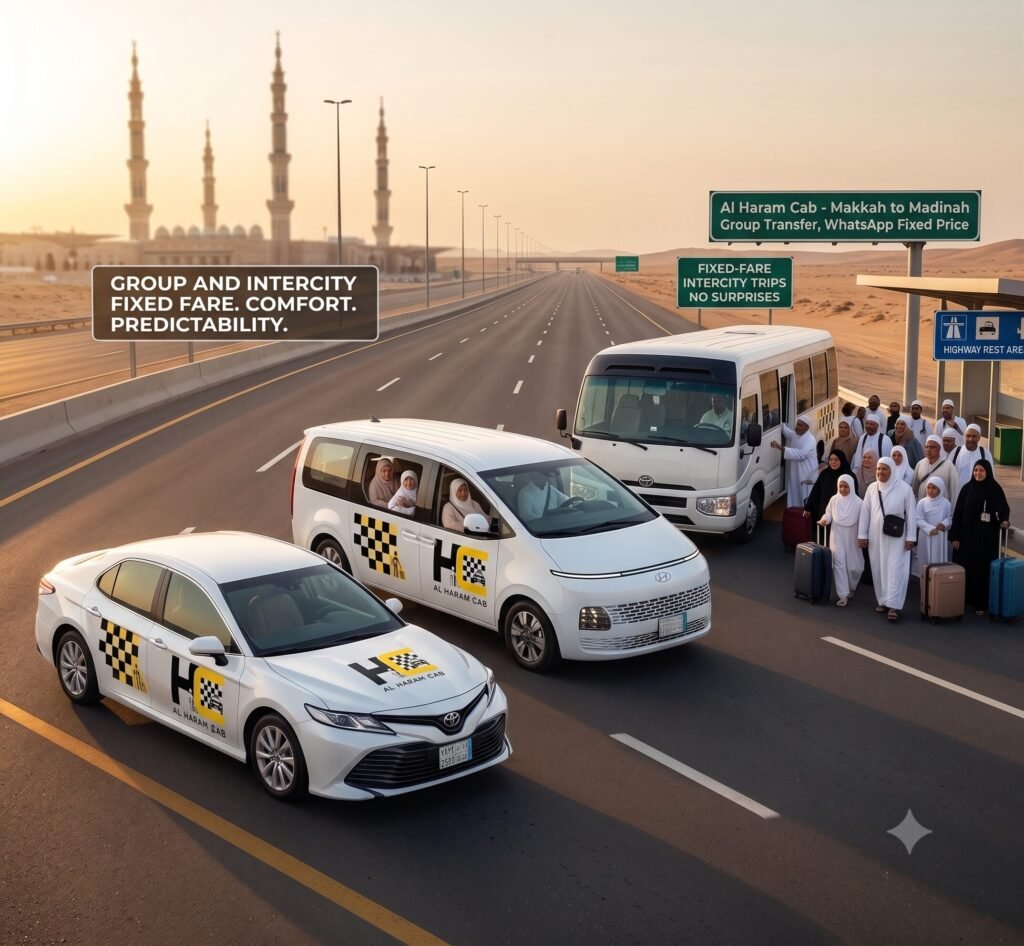
Every intercity and airport booking with Al Haram Cab follows the same principle: a fixed, all-inclusive price agreed over WhatsApp before you travel, not a number that shifts once you’re on the road. That solves most of the frustration travelers run into with cab fares generally — no meter anxiety on a long highway stretch, no haggling at the airport curb, and no surge multiplier doubling your price mid-booking. With 15+ years of experience, 50,000+ completed rides, coverage across 22+ cities, and a 4.9/5 customer rating, the fixed-fare approach is simply how every booking is structured from the start.
Vehicle Options and What They Cost to Book
The fleet is built around matching vehicle size to group size, which is where a lot of the real savings happen on longer trips. The Toyota Camry comfortably seats 4 passengers with 4 pieces of luggage and remains the most economical option for solo travelers, couples, or small families. For groups of up to 7, the Hyundai Staria, H1 Hyundai, and GMC Yukon each offer matching passenger and luggage capacity, making them the practical middle tier for extended families and small Umrah groups. Larger parties are covered by the Toyota Hiace, seating 11 passengers, and the Toyota Coaster, which scales up to 17–19 passengers for full pilgrimage groups traveling together. Because every fare is quoted per vehicle rather than per person, choosing the right size for your group is the single biggest factor in keeping your per-person cost down, whether you’re booking a short airport transfer or a full cross-country trip.
What Affects Your Cab Fare
A handful of factors consistently move fares up or down regardless of which pricing system you’re dealing with. Distance is the obvious one, but time of day matters almost as much with metered taxis and ride-hailing apps, since heavier traffic means more minutes on the clock even over an identical route. Vehicle category plays a role too — a standard sedan will always cost less than an SUV, van, or premium vehicle, and that gap widens further with ride-hailing apps that price comfort and luxury tiers noticeably higher than their economy equivalent. Seasonal demand is arguably the biggest swing factor of all in Saudi Arabia specifically, since Ramadan, Hajj, and Eid periods push prices upward across every mode of transport at once, from city taxis to intercity operators to domestic flights.
Luggage volume can factor into intercity quotes too, since a group with unusually large baggage may need a bigger vehicle than passenger count alone suggests — mentioning this upfront avoids a mismatch on pickup day. And how you book matters: a price agreed in writing beforehand, whether via a meter, an app estimate, or a WhatsApp quote, is a fundamentally different experience from discovering the price only after you’ve arrived.
How to Avoid Getting Overcharged
A few habits keep you paying a fair price. Stick to licensed, metered taxis — green or turquoise vehicles — for short city trips, and confirm the meter is running before you set off. In an unmetered white taxi, agree on the full price verbally, including luggage or waiting charges, before the car moves. For ride-hailing apps, check the fare estimate before confirming, and if it looks unusually high, waiting a few minutes for surge pricing to ease is often worthwhile.
For intercity and Umrah routes, get your price in writing before the vehicle leaves, and confirm what’s included — tolls, fuel, rest stops — so there’s no ambiguity hours into the journey. Booking ahead of Ramadan, Hajj, and Eid rather than last-minute is the most reliable way to avoid inflated peak-season pricing, since availability tightens and rates climb together during those windows.
For trusted long-distance travel and premium city-to-city transport in Saudi Arabia, you can explore reliable services offered by Top’s Transport.
Cab Fare vs Ride-Hailing vs Al Haram Cab: Which Should You Choose
Each option genuinely suits a different kind of trip, and picking the right one comes down to distance, group size, and how much predictability you want going in.
| Option | Best For | Pricing Style |
|---|---|---|
| Metered city taxi | Short trips within one city | Meter-based, transparent if licensed |
| Uber / Careem | On-demand city rides, solo travelers | App fare estimate, surge pricing at peak times |
| Al Haram Cab (intercity) | Airport transfers, Umrah routes, group travel | Fixed fare agreed in advance, no surprises |
For a quick errand across Riyadh or Jeddah, a metered taxi or a ride-hailing app is perfectly practical and usually the cheapest option available. For anything crossing between cities — an airport pickup, a Jeddah-to-Makkah transfer, or the long Riyadh-to-Madinah run — a dedicated intercity operator with a fixed-fare model removes the biggest source of stress from an already long day of travel, particularly for families, pilgrims, and groups who value knowing the exact cost before they ever leave the curb.
How to Book with Al Haram Cab
Booking takes just a few minutes, even for travelers juggling flight times and jet lag. Use the quick booking form on the website to select pickup and drop-off points, passenger and luggage count, preferred vehicle, and travel date — it routes straight to WhatsApp to confirm details. Or message the team directly at +966 59 931 0960 with your route, date, and group size for a fixed price and driver details before you step into the car. Sharing your flight number lets the team track arrivals automatically, so a delay doesn’t leave you stranded or renegotiating on landing.
Conclusion
Cab fares in Saudi Arabia aren’t as unpredictable as they seem once you know which of the three pricing systems applies — metered city taxis, dynamic ride-hailing apps, or fixed-fare intercity operators. Short city trips are cheapest through a licensed metered taxi or an app booked outside peak hours, while any journey between cities is almost always better handled through an operator who quotes one fixed price before you travel. With a fleet from the Camry for small groups up to the Coaster for full pilgrimage parties, and every fare agreed in writing beforehand, Al Haram Cab removes the guesswork from exactly the trip where it costs the most.
Frequently Asked Questions
How much does a taxi cost per kilometer in Saudi Arabia?
Standard metered city taxis typically charge a base fare of around 10 to 15 SAR plus roughly 2.5 to 3 SAR per kilometer, though this varies slightly by city and rises with heavier traffic.
Is it cheaper to use Uber, Careem, or a regular taxi in Saudi Arabia?
For short city trips outside peak hours, ride-hailing apps and metered taxis are usually similar in price, but surge pricing during busy periods can make apps more expensive; for longer intercity routes, a dedicated fixed-fare operator is typically the better value.
How much does an intercity taxi cost between Saudi Arabia’s major cities?
Fixed sedan fares generally range from around 200 SAR for shorter hops like Jeddah Airport to Makkah, up to 900–1,200 SAR for longer routes like Riyadh to Madinah, with larger vehicles priced higher.
Do I need to tip taxi drivers in Saudi Arabia?
A 10 percent tip is customary though not legally required, and it’s a reasonable gesture for good service on both short city rides and longer intercity trips.
Why does Al Haram Cab use fixed fares instead of a meter for intercity trips?
A meter works well for short city distances, but for multi-hour highway journeys a fixed fare agreed in advance protects travelers from mid-trip price changes and gives a clear total cost before departure, which matters most for families and pilgrims traveling with luggage and limited flexibility to switch vehicles mid-route.